
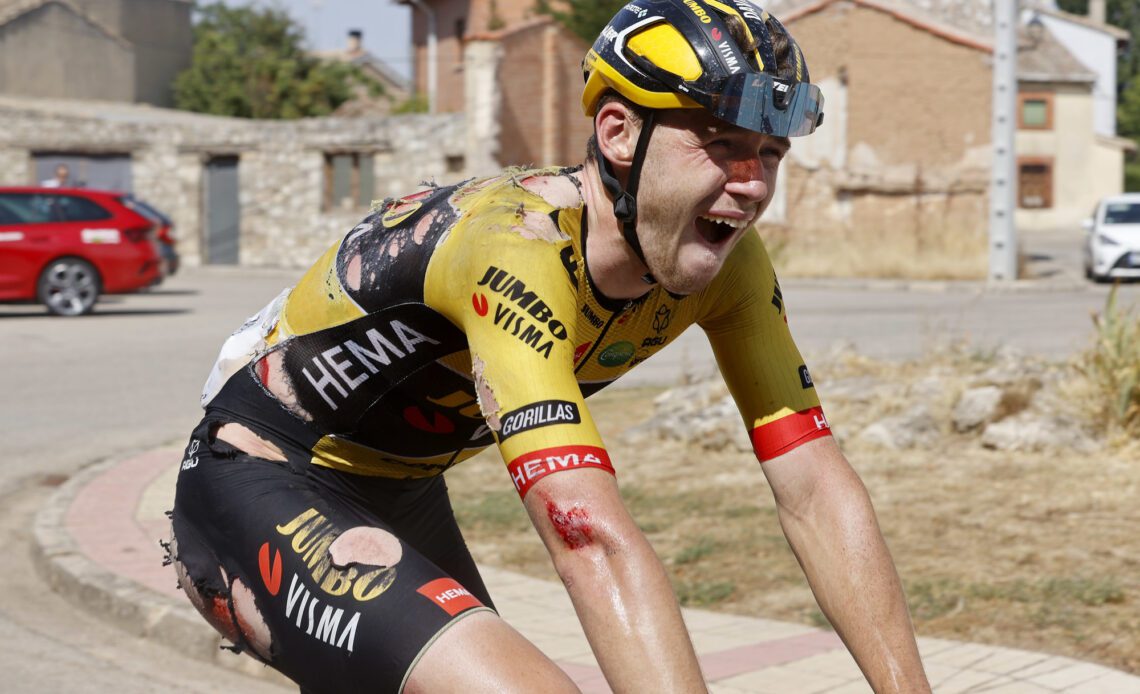
Shocking crashes in the final kilometres of Wednesday’s stages in the Tour de Pologne in Rzeszów and Vuelta a Burgos in Villadiego have highlighted the ineffectiveness of the UCI safety rules and guidelines for the courses of major races.
The UCI “Specifications for Organisers (opens in new tab)” published in February 2021 in response to the horrific crash of Fabio Jakobsen in the opening stage of the 2020 Tour de Pologne added measures intended to prevent deficits in the course and barrier design from endangering riders.
The Specifications for Organisers state: “There must be no obstacles such as road narrowings, traffic islands and speed bumps in the final kilometre. The finishing straight should observe several safety considerations and must be carefully chosen bearing these requirements in mind.
“The finishing straight should be as long as possible, at least 200m. It should also be sufficiently wide, at least 6m, and ideally 8-10m. The road width must be consistent and must not narrow at all.”
The document also states explicitly “As per article 2.2.089 of the UCI Regulations (opens in new tab)organisers are obliged to observe the various requirements of this document as well as of the UCI Regulations.”
However, the Vuelta a Burgos organisers included a speed bump in the final kilometre of stage 2 (see video below) that caused Jumbo-Visma’s David Dekker to lose control and crash in front of the peloton, who were hurtling at full speed into the fast, downhill sprint.
Not only did the speed bump spark the incident, the barriers along the section of course failed to hold together when riders fell into them, evoking the unsettling images of Jakobsen’s crash in 2020.
In the Tour of Poland, a drastic narrowing of the road from two lanes to one sparked another mass crash near the front of the peloton inside the final kilometre.
The aforementioned article 2.2.089 applies to UCI WorldTour, UCI ProSeries, and UCI Women’s WorldTour events such as the Tour de Pologne (UWT) and Vuelta a Burgos (2.Pro).
The incident in the 2020 Tour de Pologne led to reforms of the UCI safety measures that added requirements for the barriers used in the final kilometre of races, stating, “The barriers must be weighted down so that they do not move in strong winds or when subject to pressure by spectators or other forces.”
The barriers at Vuelta a Burgos broke free in a similar fashion to those in Jakobsen’s crash, though they were heavier and did not fly into the course. Fortunately,…
Click Here to Read the Full Original Article at CyclingNews RSS Feed…