

One of the major tech stories that came out of the 2025 Tour de France was the dominance of aero bikes. The reason for this development is speed. Since the pros are now going so fast, averaging more than 40 km/h, even on big mountain days, aero matters all the time. Tadej Pogačar rode all the Tour de France’s road stages on Colnago’s Y1Rs—an unapologetically all-out aero bike—despite having access to the lighter V5Rs. Jonas Vingegaard similarly rode the entire Tour on Cervélo’s S5, even though he could have hopped on the newly launched, super-lightweight R5.
But does this hyper-focus on aero apply to the rest of us? With the opportunity to test the Van Rysel RCR-F, a full-on aero road bike, I decided to find out for myself. Van Rysel may not be familiar to many Canadians, but the brand from Lille, in northern France, has already been supplying the Decathlon AG2R La Mondiale WorldTour team (now Decathlon CMA CGM) with good success for the past two years. The bikes will be available in Canada starting this year, through a small but growing dealer network.
The aerodynamic features of the Van Rysel RCR-F
The RCR-F, with its deep profile tubes throughout, shows it’s about pure speed. According to the company, the RCR-F (F for fast, natch) is 13.6 W faster than its all-around RCR Pro (at 45 km/h). Van Rysel is confident that the RCR-F is one of the fastest aero bikes currently available. Of course, every brand says this when it launches a new bike. But Germany’s Tour magazine took an RCR-F to a wind tunnel and it just missed out on the lowest drag in the history of the test by a couple of watts. Thus, it’s the fastest bike currently raced in the WorldTour. While that claim isn’t definitive—as no single test is the last word—it is safe to say the RCR-F is among the most aerodynamic options available.
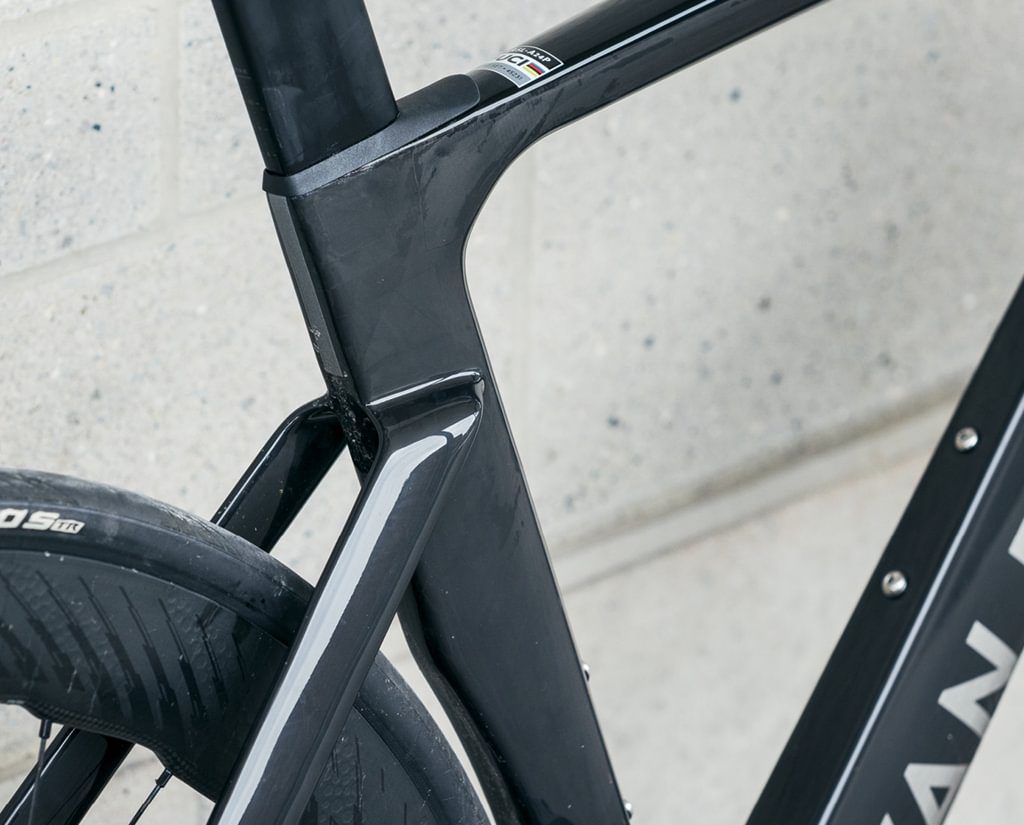
A lot of the design focus is placed on the front of the bike, where the RCR-F features one of the deepest headtubes I’ve seen on any bike. The same goes for the one-piece cockpit with its fat wing-shaped tops. Van Rysel put a lot of attention into the design of this bar. It features 12 degrees of flare from hoods to drops. On my test bike, this setup translated to a progressive 37-cm width at the hoods and 42 cm at the drops, allowing me to cut a narrower profile on the hoods and to maintain control at the hooks. The arrangement makes a lot of sense since the rider…
Click Here to Read the Full Original Article at Canadian Cycling Magazine…