

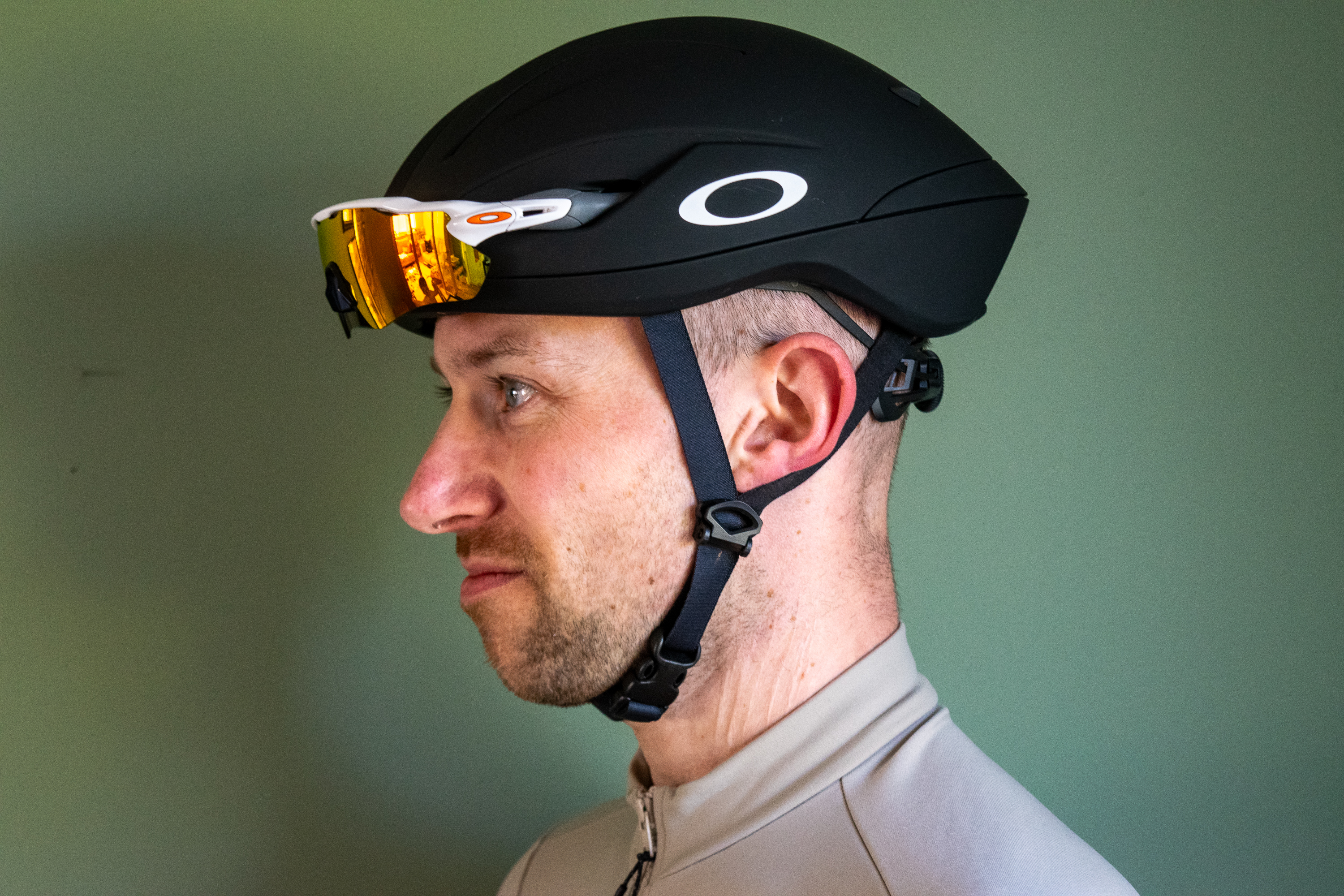
The Oakley Velo Mach road helmet has been on the market for over a year now and has created waves in that time. Developed with the Tudor Pro Cycling WorldTour team, this is Oakley’s most aerodynamic road helmet.
Oakley says it was ‘designed for real-world riding positions and sprint stage dominance’ and its minimal venting and ‘flow conditioners’ – small fins on the helmet shell to reduce drag and increase airflow attachment – hint that it could be a competitive model at first glance, and it slots in alongside the best road helmets.
It’s a nice-looking lid too, which is always important if you’re spending your own cash on kit. The Velo Mach even came out on top in our last CN Labs helmet aero test, beating the until now undisputed top dog when it comes to ‘normal’ fast road helmets, the Specialized Evade III (the old one, at least).
This is another very competitive road option if you are looking for a quick road helmet. Oakley offers it in two versions, a non-MIPS and a MIPS-equipped version. I’ve been riding in the non-MIPS version pretty much all year, using it for all of my riding, training, and for a road race. The non-MIPS version carries a RRP of £255 / $310 / €300.
We have the data from our own wind tunnel test, and months of real-world testing to pair with it now. If you care about how competitive your helmet is and are on the lookout for a new one, this review should help with your decision-making.
Image 1 of 2
Design and aesthetics
The Velo Mach is a part of Oakley’s ‘helmet eyewear system’; the helmet was designed to pair with the brand’s Velo Kato sunglasses. A concept that makes sense, given this is an Oakley helmet.
The brand will probably say you will be fastest when wearing the helmet with a pair of Velo Kato sunglasses, but not everyone is going to wear it with them. I haven’t, and you certainly don’t have to.
Oakley sponsors the Tudor Pro Cycling squad, and the Velo Mach was designed with extensive input from the team, with the overall goal of developing the fastest helmet possible. The brand doesn’t however offer up any specific aero claims regarding the helmet.
Oakley cites over 1000 wind tunnel runs as well as CFD (Computational Fluid Dynamics) in the development of the…
Click Here to Read the Full Original Article at CyclingNews RSS Feed…